The Shared Struggle, the Hidden Conflict, and the Buried Unity
Black and Brown folks didn’t end up in the same neighborhoods, the same schools, the same prisons, or the same crosshairs of the same police departments by coincidence. None of this was random. None of this was “natural tension.” None of this was “just how people are.”
It was built.
Engineered.
Structured.
And then buried so deep that later generations would think the conflict was personal instead of inherited.
To understand Black–Brown tension today, you have to understand the architecture behind it — the labor systems, the policing systems, the housing systems, the prison systems, and the psychological systems that shaped how two wounded communities saw each other.
This is the part nobody teaches.
So let’s lay it out.
1. Shared Struggles: Labor, Policing, Neighborhoods, Gangs, Prisons
Labor: The First Collision Point
From the beginning, Black and Brown labor was treated as disposable, interchangeable, and exploitable. Black folks were enslaved, then criminalized into forced labor. Mexican and Indigenous people were pushed into seasonal labor, railroad work, mining, and low‑wage industrial jobs.
Different histories, same outcome:
work that broke your back and barely fed your family.
When two groups are fighting for the same scraps, the system doesn’t have to divide them — scarcity does the job.
Neighborhoods: Redlining and Containment
Black and Brown families were pushed into the same neighborhoods through:
- Redlining
- Racial covenants
- Segregated schools
- Discriminatory lending
- “Urban renewal” that destroyed Black and Brown communities and relocated them into the same compressed areas
These weren’t neighborhoods — they were containment zones.
And when you squeeze two struggling communities into the same limited space, you create tension by design.
Policing: Two Stereotypes, One Target
Police departments in the Southwest were trained with two different scripts:
- Black people = dangerous
- Mexicans = foreign
Different labels, same treatment:
surveillance, harassment, brutality, and criminalization.
Black folks were policed as threats.
Brown folks were policed as outsiders.
Both were policed as problems.
Gangs: Survival, Not Evil
Gangs didn’t start as criminal enterprises.
They started as:
- Protection
- Identity
- Neighborhood defense
- Survival networks
When the state abandons a community, the community builds its own structure.
But when two abandoned communities live side‑by‑side, those structures collide.
Prisons: The Final Funnel
Black and Brown men were funneled into the same prisons through:
- Discriminatory sentencing
- Targeted policing
- Economic desperation
- School‑to‑prison pipelines
Inside, the system doubled down on division.
Segregation, racial politics, and survival rules hardened the lines that started outside.
But even in prison, unity scared the system more than violence ever did.
2. Hidden Conflicts: How Systems Quietly Played Groups Against Each Other
This is the part that explains everything.
The U.S. Used Racial Triangulation
Meaning:
positioning groups relative to each other to keep them from uniting.
Black folks were placed at the bottom of the racial hierarchy — the “permanent underclass.”
Mexicans were placed in a weird middle zone — sometimes labeled white on paper, treated as non‑white in reality.
This created confusion, resentment, and insecurity.
Divide‑and‑Control Tactics
The system used:
- Different stereotypes
- Different legal categories
- Different policing strategies
- Different immigration narratives
- Different economic roles
…to make each group think the other had some kind of advantage.
Black folks were told Mexicans were “taking jobs.”
Mexicans were told Black folks were “dangerous.”
Both were told the other was the reason resources were scarce.
Meanwhile, the real issue was the system starving both communities.
Media Played a Huge Role
For decades:
- Black people were portrayed as criminals
- Mexicans were portrayed as invaders
Two different fears, aimed at two different groups, but both designed to justify the same policing and the same political control.
Colorism and Colonialism Added Fuel
Latin America has its own racial hierarchy — a leftover from Spanish colonialism — where lighter skin is valued and Blackness is stigmatized.
When Mexican and Central American immigrants came to the U.S., they brought that colorism with them.
When they arrived in Black neighborhoods, the U.S. layered its own anti‑Blackness on top.
The result:
a double dose of anti‑Black conditioning.
Not because people were evil — but because they were trained.
3. Buried Alliances: The Times Black and Brown Folks United — and It Mattered
This is the part they never teach, because unity is dangerous to the people in power.
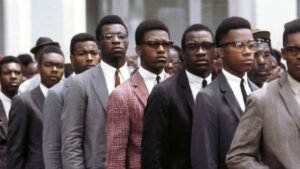
The Black Panthers and the Brown Berets
They worked together on:
- Community patrols
- Free breakfast programs
- Anti‑police‑brutality campaigns
- Political education
- Neighborhood defense
They saw each other as allies, not rivals.
The Original Rainbow Coalition
In Chicago, Black, Mexican, Puerto Rican, and even poor white groups united to fight:
- Police violence
- Poverty
- Housing discrimination
- Political corruption
The government responded with infiltration, surveillance, and targeted arrests.
Unity was a threat.
Farmworker Movements
Black organizers marched with Mexican and Filipino farmworkers.
They shared strategies, resources, and political pressure.
Prison Alliances
There were moments — rare but powerful — when Black and Brown inmates united against abusive guards or inhumane conditions.
Those moments forced policy changes.
Civil Rights Lawsuits
Black and Mexican plaintiffs often combined cases to show broader discrimination patterns.
Together, they won cases that neither group could’ve won alone.
The Raw Truth Underneath All of It
Black and Brown folks were never natural enemies.
They were placed in conflict.
They were told stories about each other.
They were conditioned to distrust each other.
They were punished when they united.
They were starved of resources and then blamed each other for the hunger.
The real enemy was never the other community.
It was the system that needed both communities weak, divided, and distracted.
Because when Black and Brown folks unite, they don’t just survive — they change the landscape.
And that’s the part history tried to erase.