
A northern city, a southern mindset, and a country that watched the fire from a safe distance.
This isn’t a story about a “riot.”
This is a story about what happens when a city decides a whole community is disposable —
and the country shrugs like it’s normal.
The 1917 East St. Louis Massacre wasn’t random chaos.
It was the collision of the Great Migration, wartime industry, white labor panic, and weaponized racism —
and it turned one American city into a battlefield where only one side was allowed to be human.
Where East St. Louis Is — And Why It Was a Powder Keg
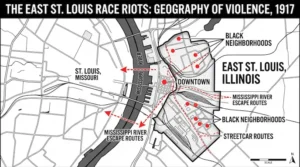
East St. Louis sits on the Illinois side of the Mississippi River, staring directly at St. Louis, Missouri.
In the early 1900s, this wasn’t some quiet town — it was a full industrial machine: stockyards, railroads, factories, meatpacking plants, steel mills.
A place where the Great Migration collided with wartime industry, racism, and economic fear — all inside one city.
By 1917, East St. Louis wasn’t just a location.
It was a pressure cooker with the lid welded shut.
Timeline: East St. Louis Massacre, 1917
- 1910–1916: Great Migration brings thousands of Black families north.
- Early 1917: White workers strike; companies recruit Black workers as replacements.
- May 28, 1917: First riot — white mobs attack Black residents.
- June 1917: Newspapers pour gasoline on the fire.
- July 1, 1917: A shooting involving plainclothes police becomes the spark.
- July 2, 1917: Full-scale massacre erupts.
- July 3, 1917: Troops restore order — after the damage is done.
- July 28, 1917: NAACP leads the Silent Parade in NYC.
- 1918–1920s: Hearings, reports, and almost no justice.
“East St. Louis didn’t explode out of nowhere — it was a match dropped in a room the city had been filling with gasoline for years.”
Before the Fire: Migration, Labor, and a City on Edge
The Great Migration was in full motion. Black families were leaving the South — escaping lynchings, Jim Crow, and the kind of “law” that only protected one side.
They came north chasing jobs, safety, and a chance at something better.
East St. Louis needed workers.
World War I was booming. Factories were desperate. Immigration from Europe had slowed. White workers were being drafted.
So companies did what companies always do when profit is the only god they serve:
They brought in Black workers — and used them as leverage against white unions.
White workers didn’t blame the companies.
They blamed the Black families who were just trying to survive.
Newspapers fanned the flames with headlines about “negro invasion” and “Black domination.”
Politicians rode the fear like a campaign strategy.
The city wasn’t just tense.
It was primed.
May 28, 1917: The Riot Everyone Pretended Wasn’t a Warning
A rumor — the oldest spark in America — that a Black man insulted a white woman.
White workers angry about Black strikebreakers.
A mass meeting at City Hall where speakers basically said, “They’re taking over.”
When the meeting ended, the mob didn’t go home.
They went hunting.
Black residents were beaten in the streets.
Streetcars were stopped and searched.
Black passengers were dragged off and assaulted.
Businesses were smashed.
People were killed.
And the city’s response?
“It’s fine. Everything’s fine.”
They ignored the warning.
And the next explosion made May look like a warm-up.
July 1, 1917: The Spark That Lit the Fuse
Reports spread that a car full of white men was driving through Black neighborhoods firing shots.
Black residents — already traumatized from May — armed themselves.
Later that night, another car rolled through.
Believing it was the same attackers, Black residents fired back.
But this time, the car held plainclothes police officers.
Two were killed.
White East St. Louis didn’t see context.
They didn’t see fear.
They didn’t see self-defense.
They saw an excuse.
July 2, 1917: The Day the City Turned on Its Own
What happened next wasn’t a riot.
It wasn’t chaos.
It was targeted racial violence — organized, deliberate, and devastating.
White mobs — workers, townspeople, and even some law enforcement — stormed Black neighborhoods.
Homes were set on fire.
Families were attacked as they ran.
People were beaten, shot, lynched.
Some were pulled off streetcars.
Some were chased down alleys.
Some were thrown into burning buildings.
Black families fled toward the Mississippi River — some by bridge, some by boat, some by jumping into the water praying they’d make it across.
Official numbers said 39 Black people died.
Witnesses said it was easily over 100.
Some said closer to 150.
Entire families lost everything in a single day — homes, loved ones, and any sense of safety.
“In East St. Louis, the question was never whether authorities could stop the violence — it was whether they ever intended to.”
Where Were the Authorities?
Some police stood by.
Some joined in.
Some disarmed Black residents trying to defend themselves — while letting white attackers continue.
The National Guard eventually arrived, but slowly.
By the time they restored order, whole neighborhoods were ash and memory.
The Human Cost: Trauma That Didn’t End in 1917
Around 6,000 Black residents were left homeless.
Many fled the city forever.
Those who stayed rebuilt from nothing — in a place that had just shown them how little their lives were valued.
Children watched their homes burn.
Parents watched their families scatter.
Trauma became part of the city’s DNA.
America Reacts: Shock, Silence, and the Silent Parade
Black newspapers told the truth.
White newspapers softened it.
The NAACP investigated and documented everything they could.
On July 28, 1917, 10,000 Black men, women, and children marched silently down Fifth Avenue in New York City —
holding signs like:
“Mother, do lynchers go to heaven?”
“Thou shalt not kill.”
It was one of the first major civil rights demonstrations in American history.
Congress held hearings.
Officials pointed fingers.
But justice?
Barely any.
Why It Happened: Race, Labor, and Power
- Racism: The belief that Black lives were worth less.
- Economic fear: White workers terrified of losing jobs.
- Employer manipulation: Companies using Black workers as strikebreakers.
- Political failure: Leaders ignoring every warning sign.
- Media incitement: Newspapers amplifying fear instead of calming it.
Put all that in one city already on edge —
and the result was catastrophic.
What America Learned — Or Pretended Not To
East St. Louis should have been a turning point — a moment when the country admitted that racial violence wasn’t just a “Southern problem,” and that Black lives were in danger anywhere profit and prejudice lined up on the same side.
Instead, America did what it often does with its ugliest stories:
- It localized it: “That was just East St. Louis.”
- It minimized it: “The numbers are exaggerated.”
- It rationalized it: “Tensions were high. Both sides…”
- It moved on: No real reform. No real reckoning.
But the people who lived through it didn’t move on.
They carried the memory into Chicago, Detroit, St. Louis, and every other city where the Great Migration continued —
knowing that the North was not a safe escape from racism, just a different version of it.
The Legacy: A Warning America Still Hasn’t Fully Heard
The East St. Louis Massacre didn’t just destroy buildings.
It scarred generations.
Some survivors never spoke of it again.
Others made sure their children knew exactly what happened —
because silence is how history repeats itself.
The massacre is now recognized as one of the deadliest episodes of racial violence in U.S. history.
A reminder that racism isn’t regional — it’s national.
And it can erupt anywhere when fear is weaponized.
America has a habit of burying the stories that make it uncomfortable —
but the ground never forgets what was done on top of it.
East St. Louis is one of those places where the truth still echoes,
waiting for a country brave enough to listen.
Sources & Further Reading
- 📚
NAACP Archives — Investigations & Silent Parade Documentation
- 📰
Library of Congress — 1917 Newspaper Coverage (Black & White Press)
- 📘
“The 1917 Race Riot in East St. Louis” — University of Illinois Press
- 🗂️
National Archives — Federal Hearings & Testimonies (1917–1920s)
- 🎙️
Oral Histories from Survivors & Descendants
- 🏛️
BlackPast — East St. Louis Massacre Overview & Analysis